
AFTERMATH – POST-NUCLEAR SURVIVAL
When the world around you collapses, survival becomes your story.
Concept & Inspiration
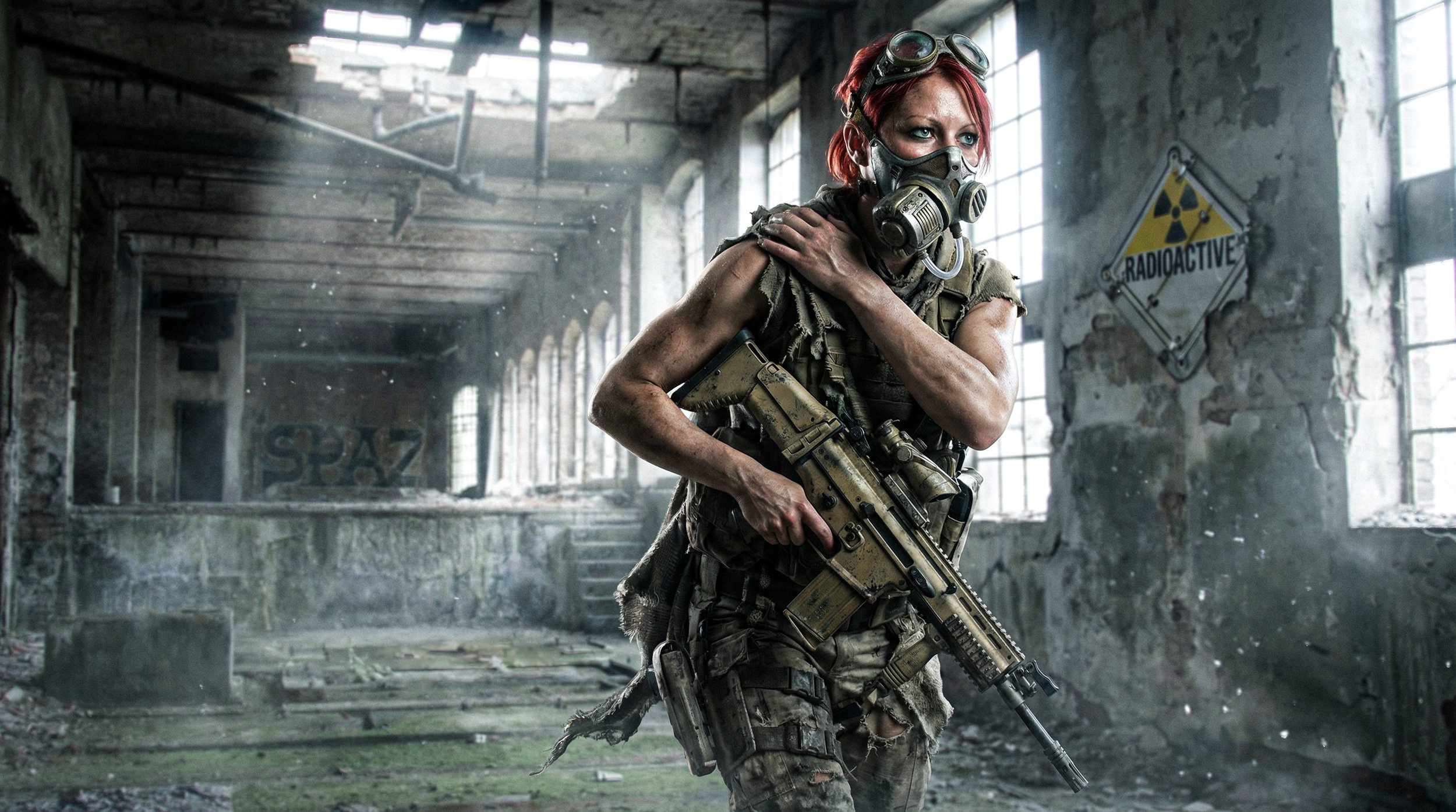
Aftermath—Post-Nuclear Survival began as a personal experiment in 2015, exploring the intersection of human resilience and the stark visual language of post-apocalyptic landscapes. At the time, the piece was a black-and-white Photoshop composite featuring a lone figure in an abandoned building — a frozen moment of tension, isolation, and survival.
Ten years later, the desire to revisit this concept stemmed from a curiosity: how would the same idea look through the lens of today’s technological and artistic standards? With advances in AI-assisted image creation, cinematic rendering, and hyper-realistic texture work, I saw the opportunity to evolve the original concept into a fully immersive, grounded, and emotionally resonant scene.
Creative Process
The evolution of this piece was driven by storytelling, realism, and cinematic aesthetics. Rather than simply replicating the original, the goal was to create a narrative frozen in motion, a female soldier navigating the chaos of a post-nuclear environment, searching for escape, burdened by exhaustion, and defined by endurance.
Key considerations included:
Character realism: Every detail of her tactical gear, respirator mask, and weapon was carefully imagined and textured to show wear, dirt, fraying, and long-term use. Subtle human imperfections, sweat on skin, abrasions, and asymmetrical posture enhance authenticity.
Environmental storytelling: The abandoned concrete building was designed to tell its own story: collapsed ceilings, exposed rebar, broken windows, and floating dust illuminated by natural light, all of which immerse the viewer in a believable post-apocalyptic setting.
Lighting & composition: The scene was conceptualised as a cinematic still from a high-budget dystopian film, balancing natural rays of sunlight with professional strobe flash to accentuate detail, depth, and realism. Shallow depth of field and careful lens choices create intimacy while preserving the scale and chaos of the environment.
Emotional resonance: The subject’s expression and posture convey resilience under duress; pain, worry, and determination are captured without exaggeration, allowing viewers to feel the tension of survival and the weight of solitude.
Execution
Using a combination of the original 2015 source files and AI, I blended hyper-realistic textures, lighting effects, and cinematic composition techniques. Every element, from floating ash particles to the worn desert-camo FN SCAR, and from subtle rim lighting to misted air, was meticulously crafted to enhance immersion and believability. The result is a full-colour, high-dynamic-range, editorial-style image that retains the emotional depth of the original black-and-white work while expanding it into a modern, cinematic, and grounded aesthetic.
Reflection
Aftermath—Post-Nuclear Survival is as much about conceptual storytelling as it is about technical execution. Revisiting this work after a decade allowed me to explore how technology, imagination, and emotional nuance intersect to create a single frozen moment that feels alive. It reflects the evolution of my creative process and serves as a bridge between past experiments and present capabilities, a testament to endurance, both human and artistic.
THE RADIATION ZONE (2015)
AFTERMATH (2025)